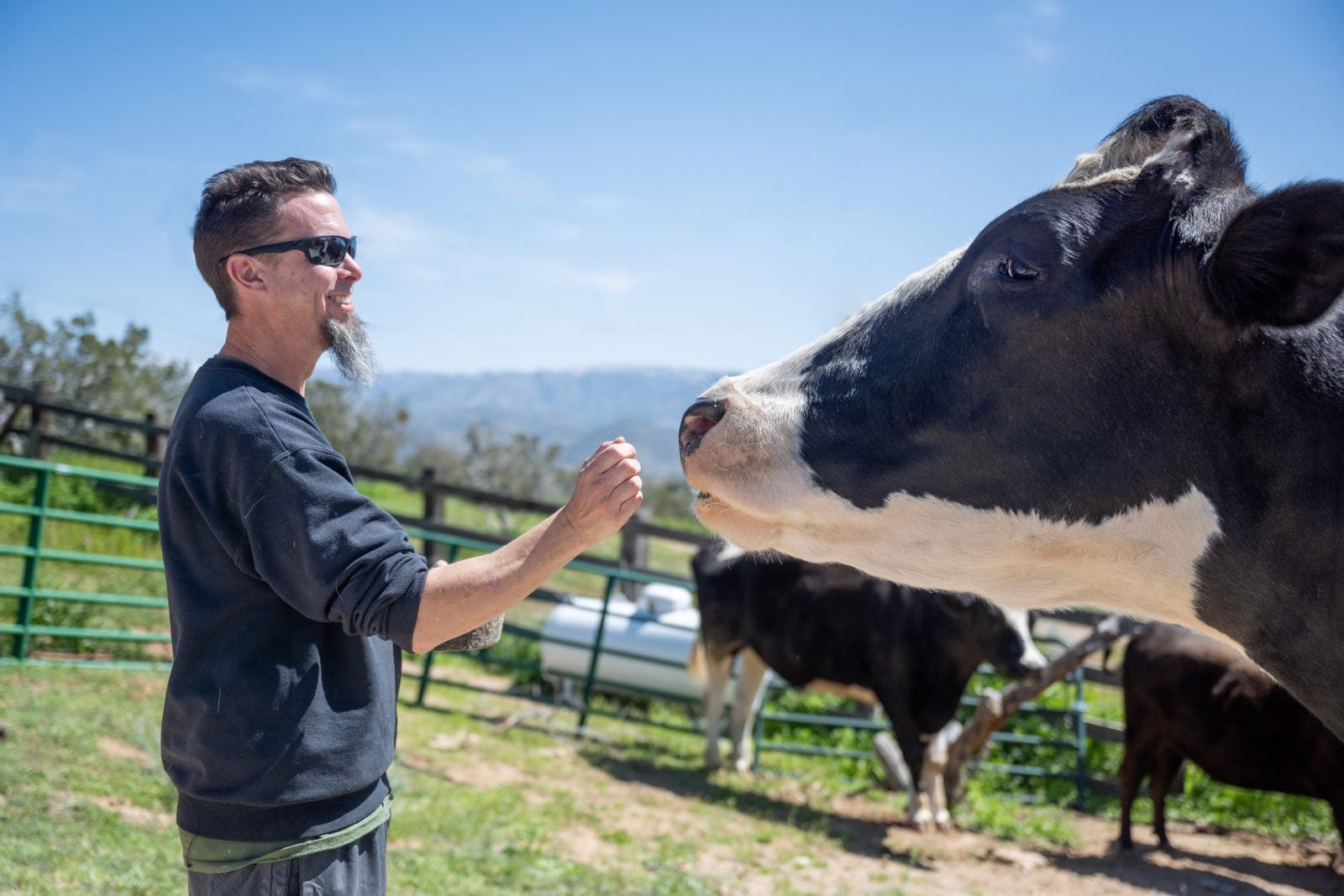
For a moment, consider what friendship means to you. How does it influence your life, relationships, and well-being? No matter the challenges and joys brought by it, we know that friendship, simply put, is extraordinarily valuable. We know comparatively little, however, about cooperative and friendly relationships among non-human animals, especially compared easier-to-study behaviors such as the ways animals satisfy their hunger or reproduce or avoid predators. What does it mean for an animal to invest in and prioritize a positive connection with another individual of its own species? How might that affect their lives and welfare?
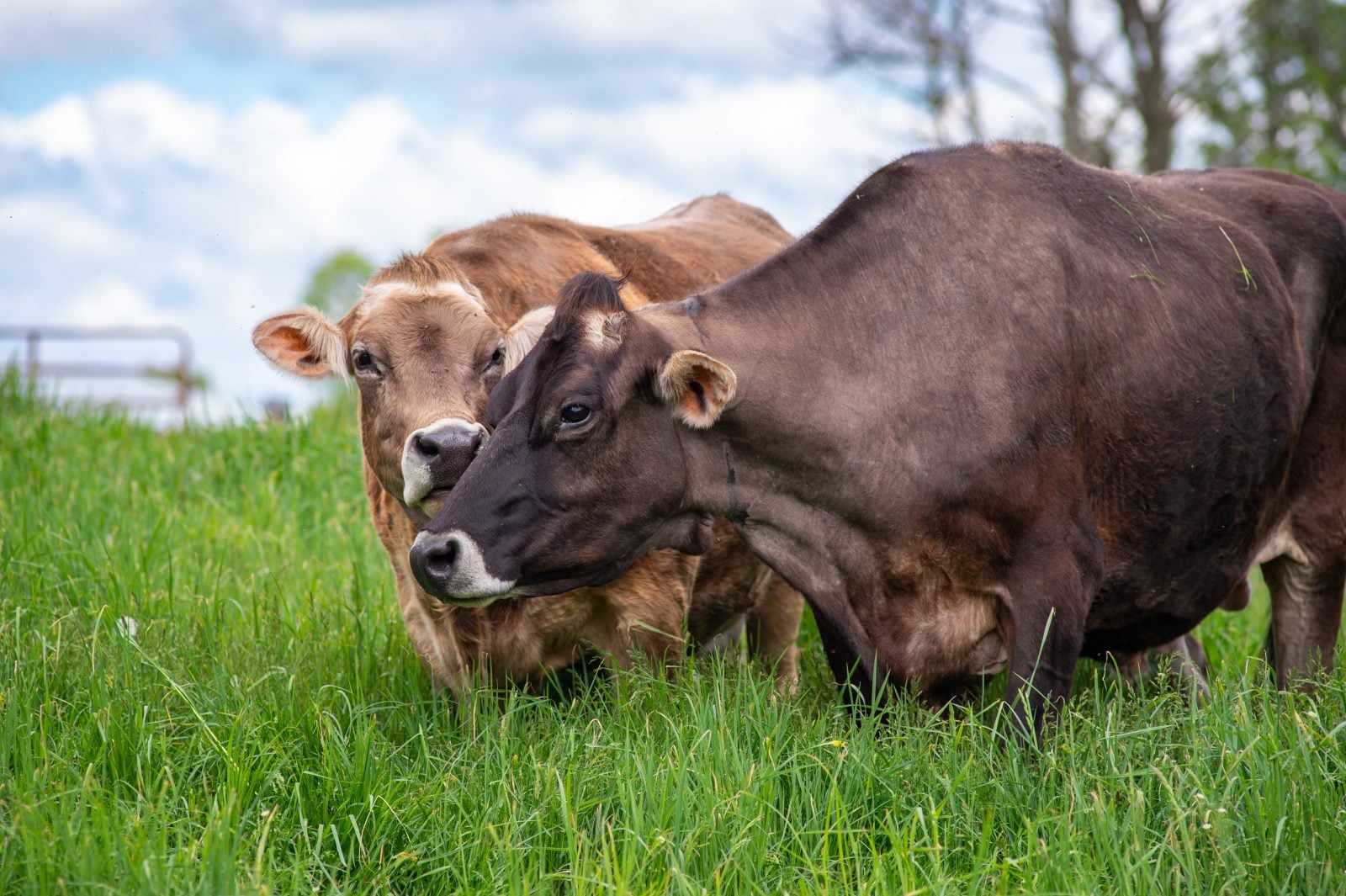
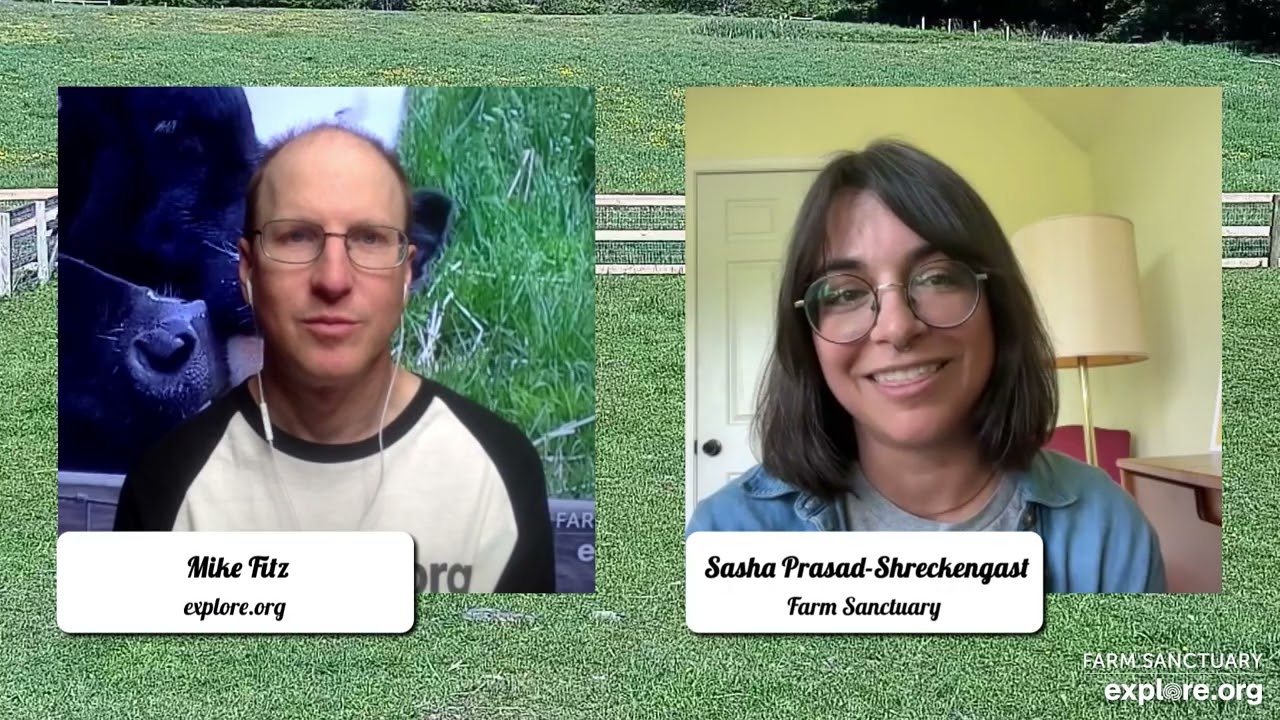
Hi, everyone. This is Mike Fitz. I am the resident naturalist with explore.org, a community science project with Farm Sanctuary aimed to illuminate our understanding of affiliative relationships among domestic cattle, who are one of the most numerous animals on the planet and, unfortunately, one who is often subjected to unnatural conditions to produce meat and dairy foods for our consumption.
Through the study of Farm Sanctuary, we might gain a better understanding of social bonds in cattle and apply that knowledge to give them better lives under our care. To help us learn more about it and how to contribute your webcam observations to the study, I'm joined by Sasha Prasad-Shreckengast, who is a researcher at Farm Sanctuary. Sasha, thanks so much for taking the time to join me. I'm really excited to learn about your study.
Thank you so much for having me, Mike.
We know that dominance confers advantages for individual animals, and that's pretty well-established in the scientific literature. And we can see it just by watching a group of animals do their thing. And because a dominant animal can gain priority access to food, it can-- maybe more reproductive opportunities or gain access to safer habitat, but what advantages does friendliness or cooperation provide?
Yeah, absolutely. So there certainly are numerous benefits to these friendly types or affiliative relationships among social animals. We have seen in the literature that there's a reduction in risk to injury. There are also stress benefits in the sense that these relationships can lower ambient stress. And we've also seen benefits in the facilitation of social learning. And these are especially beneficial within structured dominance hierarchies because they can provide animals with an additional sense of predictability and stability within their social structure.
I'm curious about cattle, though. You have many animals at Farm Sanctuary, but what inspired you to study the social relationships of domestic cattle?
Yeah, so I have been at Farm Sanctuary for five years, but Farm Sanctuary is celebrating its 40th anniversary this year. So the organization has decades of experience of caring for cows and witnessing the types of relationships that they seem to form with one another. So I'm really grateful and excited for the opportunity to take those lived experiences and those observations and investigate them through the scientific lens.
And then the conditions of Farm Sanctuary, they differ from those experienced by most cattle, especially those designated or destined to be slaughtered for food. So how are cows-- what is their life and experiences like at Farm Sanctuary compared to maybe other cows?
Yeah, it's a super unique environment when you compare it to, like you alluded to, the norms within the animal agriculture system. So we have mixed-breed herds and mixed-age herds. So we have cows who would be otherwise raised for dairy living alongside cows who would otherwise be raised for meat consumption in the same herd. Our herds range in age from a few years to near 20 years old. So we just have a lot more diversity in our herds.
And then as far as the lives that they live and the conditions that they live under, there's a lot more autonomy and choice in their environment. They're able to choose where to go, who to spend time with, what aspects of the environment to engage in to a degree that is less likely to be seen within animal agriculture.
So it sounds like they're going to be able to-- or they're able to express maybe a more full range of their natural behaviors and have more choices in that sense. And maybe that is an idea that we can think about as we're talking about the study. So I want to ask you a few questions now about this relationship study for cows. First of all, just maybe give us a big picture of the study itself. How does it work?
Yeah, so we're going to be watching our cow herd interact-- the individual members of the herd interact with one another and just capture the types of interactions that they're having, whether they're these friendly or affiliative relationships or interactions or the dominance or aggressive interactions. And we're going to be doing that through our Explore cameras that we have set up outside of the barns. And the goal of the study is to see whether-- or how the affiliative relationships manifest and whether we can identify friendships more specifically within those affiliative bonds.
And that seems to be the main thing that you're trying to document. Is that correct? The more friendly and affiliated relationships-- is that your main goal?
Correct. Yes. We know that there will be a dominance hierarchy within this herd because that is how cattle groups arrange themselves socially, and we are interested to see how or whether that dominance hierarchy impacts these friendly relationships at all. So that is still a piece that we're looking at, but, yes, our main goal is to look at the friendly relationships within the herd.
And then how does this study differ from maybe most all other studies on cows, especially research set in animal agriculture settings?
I think the biggest difference is that there's just that diversity in the herd that I alluded to. Within the animal agriculture industry, especially if we're thinking of the dairy industry, we're looking at behaviors of a single breed of very similar ages and very similar reproductive-- or at points in the reproductive lives, where here, we don't have those constraints.
So we're looking at a wide diversity of traits that you just simply can't study within the animal agriculture industry as it's currently configured. Yeah, and I think also the different-- or the increased autonomy that they're able to have. That will just provide a different lens to this study as well.
Are there specific qualities of cows that lend themselves well to this type of study? I don't have much experience around cows themselves. Of course, I've seen them along the roadside and been up close to them a few times, but just haven't been involved in that world. So, yeah, I'm really curious about the animal themselves-- cows. What lends themselves well to this study?
So for this study in particular, since we are looking at the affiliative relationships, cows are-- it's pretty-- or I'll say, it's easier to tell when they are having a friendly interaction because it usually manifests itself as allogrooming, which is just when one individual licks another. And that's a pretty straightforward behavior to be able to capture via video.
And then also, just from experience and anecdotes from our caregivers, there is just a lot of observations of what these individuals define as friendships or friendly relationships. So we know that, even in a non-scientific or an untrained setting, people are able to identify these relationships, or they believe they're able to identify these relationships. So there's a good track record, at least anecdotally, in identifying friendships. So we're eager to see whether we can confirm that through the scientific process.
And I was just thinking, too, that the cows are pretty easy to identify. It's not just their behaviors, but their different patterns. It's not like a group of sheep, for instance. If we look at the sheep barn, for instance, it's a big group of sheep, and they know who each other are, but it's much harder for me to tell who's who. It's probably a lot easier with cows.
Yes, thank you for highlighting that because that is a huge reason why we chose this herd in particular and this group of animals because they are all fairly straightforward to identify visually.
Let's talk more about the behaviors. So you mentioned a little bit about it, but what behaviors are you looking for?
So allogrooming will be a big behavior that we're interested in. There was a study on feral cattle out of Hong Kong that showed that the friendly relationships in these individuals was primarily expressed through allogrooming. And we also see so much allogrooming. Anyone who has the opportunity to just watch the Explore cameras of the cow herds at Farm Sanctuary will probably have the opportunity to see some of that behavior in action.
So we're looking, certainly, for that, but we're also interested in other behaviors, including proximity. So how closely are they spending time with certain individuals of the herd? And then other friendly behaviors like nuzzling or social sniffing and things like that.
And then is it important for the audience to record non-friendly behaviors as well, some of those maybe dominance interactions?
Yeah, we are interested in those, too. My inkling is that those will be less frequent in our herd, just because they have these-- they have lived together for so long, that the hierarchy is pretty-- I imagine it's pretty well understood. But because that is still an interest of this study, and especially because we expect those behaviors to be kind of rare, we are certainly interested in those more conflict-oriented behaviors, including aggression.
Yeah, that's a good point. If they're all familiar with one another, they don't need to sort out the hierarchy every day. They just kind of know who's who.
That's my assumption. So I guess we'll see if that's true. OK. But, yeah, let's find out. I'm sure our sharp-eyed audience will be paying attention to that. Speaking of them, speaking of our audience, how can people participate in the study?
So what we're asking members of the public to do is log on to the Farm Sanctuary Explore cameras. Specifically, there's a camera overlooking our main cow barn and pasture. And there will be a really quick survey that they can access to just flag when behaviors that look like they might be those friendly behaviors or potentially those hierarchy-driven behaviors are being displayed.
And then if they feel confident enough to identify the individuals involved and the specific behaviors that were observed, that's a bonus. But really, all we're asking for at a minimum is the timestamp of approximately when those behaviors are happening and just submit that quick survey, and we'll take it from there.
How might this knowledge be used to help improve the physical and mental welfare of cows? Like I mentioned before, they're one of the most numerous animals on the planet. But a lot of times, the way that they're treated is out of sight, out of mind. We don't really think about it if we pull a pack of meat off the shelf or cheese or milk or whatever it happens to be.
So I'm curious about the follow-through. If you learn something, how could this-- and it's a lot of speculation that I'm asking you to do, so I apologize for that. But, yeah, how might that improve their physical and mental lives?
I think if we are able to find evidence of these friendships, I think it has multiple benefits for cows. I think for cows broadly, beyond the individuals that live at Farm Sanctuary, my feeling is that by highlighting that they have these friends and that this is another similarity that they share with the human experience, I think it has the potential to perhaps just shift how people view cows, maybe encourage them to see them as real, thinking, feeling beings and individuals rather than just a product for consumption.
So that's one way. And then there's also real tangible benefits for the individuals at Farm Sanctuary. It can help us make decisions about keeping friends together for the long term.
We already really try to do that based on the information we have currently, but this can just give us even more evidence and confidence that when perhaps there's decisions to be made from a health care perspective or maybe somebody needs to be taken to the vet, perhaps for a longer time, this can help us make decisions about maybe how it could impact other individuals rather than just the individual of focus for a medical reason. So I think there are also a lot of benefits for how we care for the individuals at Farm Sanctuary, too.
And I want to ask you a few questions about your research ethics at Farm Sanctuary because research, and even the mere attempt to ask questions, in my opinion, is a human-centered effort since it originates in our minds, right? We're observing and we're coming up with questions in our brain. Lots of research, though, historically asked important questions, but the methods to get toward the answers often discounted the welfare of animals. So I understand that you take a different approach at Farm Sanctuary. In what ways do you evaluate your research proposals to center the welfare of the animals within that study so that's always sort of in the front of everyone's minds?
Yeah, thank you for asking this question. I think it's a-- or not I think. I know it's a long-standing principle in any work with animals is to reduce the amount of harm that the animal subjects will be exposed to. But at Farm Sanctuary, we take it beyond that, whereas harm is prohibited. We are not harming the participants of the study, even if it's in the long term for their benefit or for the, quote, greater good.
But we can still do really good research within those constraints. And it's actually been a really fun challenge because in order for-- this study is purely observational, but we also do experimental studies. And those studies have to be a positive experience for the residents because we are asking them to volunteer and choose to participate in these studies. So it's been a really fun challenge for me, too, as a researcher is how can we carry out rigorous science while keeping the animals' experience at the center and prioritizing their well-being above our personal priorities as a researcher?
And I was reading on your website about your research ethics and guidelines. That philosophy that you have, it really goes beyond the study itself. It seems like you're also thinking forward, too. So what considerations do you evaluate so that harm doesn't come to the animals in the future from the things that you've learned through your work?
Yeah, we have a lot of conversations about that exact question because we recognize that we're going to make the best decisions with whatever information we have at the time, but that those decisions might exist in a real gray space. So sometimes, we might come to the conclusion that it's really important for us to name the individual residents that were involved in a study and give them the credit and highlight their individuality in that way, whereas other times, it might be really important to keep their identity more anonymous.
So, for example, at Farm Sanctuary, we've had some residents reach maybe not quite celebrity status, but Farm Sanctuary celebrity status. And we just want to be thoughtful of, depending on the individual, is that a positive experience for them? Are they really loving the human engagement and the extra attention? Or maybe are they individuals who prefer their space and don't enjoy those interactions? So those are the types of things we'll consider.
And we recognize that might not be-- when we're talking about harms, we're not talking about perhaps physical pain or those types of harms, but we're really cognizant of the social and just emotional experience that each individual could be having and recognizing that harm can be emotional as well as physical.
Yeah, each animal is its own-- are their own individual with their own personalities and dispositions. I'm confident that there are animals that are extroverted and there are animals that are introverted. So you don't want to force an introverted animal into an extroverted situation, at least most of the time. So, yeah, you really do have to know those individuals well. And I am curious about the cows that are under your care that we're going to be watching and paying close attention to through this study. Can you tell us a little bit about the cows in the main pasture and where they came from?
Yeah, so we actually have two cattle herds at Farm Sanctuary, but this is our main herd simply because they live on our main campus at Farm Sanctuary. And these pastures tend to be a bit flatter, so this is where we tend to have our older individuals or cows that might have some mobility challenges. So you'll see some of our oldest residents at the sanctuary.
And there are cows of various breeds. So you'll see cows that would otherwise be raised for dairy living alongside cows otherwise raised for meat. Males and females are both in the herd, which is, again, different from the dairy industry. Yeah, they come from diverse backgrounds. It's a really diverse group, which makes them particularly interesting to study.
And I actually hadn't even thought of that, how the diversity of ages and sexes and breeds is in itself very, very unique compared to most other experiences for virtually every cow on Earth. Are there one or two individuals that you've come to know who you think have particularly interesting stories or personalities?
I think they're all such interesting individuals, but I will highlight Pietro. So Pietro is a male Holstein steer who came to Farm Sanctuary around the same time that I did, which is why I feel like I have a especially close bond with him. So he's about five years old now, and he, as a Holstein steer, was rescued from the dairy industry as a calf.
And male dairy calves, since they will never produce milk, don't have value to the industry, so they often are either sold for veal or disposed of otherwise on the farms. But Pietro actually had a pretty severe leg injury and was receiving vet care for that injury. And then through that process, someone saw him as someone rather than just something to be discarded and advocated for him to be placed into sanctuary.
So even though that injury itself was really traumatic, and I'm sure it was incredibly painful, that ended up being what saved his life. And he was in a cast when I first met him. And he was basically the size of a German shepherd at the time, so he had one of those cones that we've seen probably on our companion dogs. And he made a full recovery and is now living an incredibly rich life with his herd of many other cows.
Well, I look forward to getting to know him just a little bit more. Just a few more questions for you, Sasha. I consider myself to be basically an observer. I'm not a scientist, but I read a lot. I spend a lot of time observing animals. From my perspective, there's a growing body of evidence within ethology, which is the study of animal behavior, and also neuroscience that's looking at brains of non-humans and human animals.
It's really illuminating our understanding of animal minds and consciousness and what animals really are capable of and what's going on inside of their heads. What trends are you seeing? I'm just curious about your opinion on this. What trends are you seeing in ethology regarding the mental experiences of non-humans? And where might that research take us in the future?
I think as ethology was becoming a field of its own, there was a real tendency to reject anthropomorphism to such an extreme that often, we weren't even imagining that there could be so many shared experiences between the human experience and an animal experience. And what I've seen happen more recently is the recognition that acknowledging these similarities isn't flawed inherently.
And I think that because of that, we are able to look at relationships like friendships in other species, and we're able to think about maybe other areas of similarities within reason. I think there are still-- there is still a real value to being really careful about overly anthropomorphizing other species. But I think on the flip side of that, too, is many other species are capable of things that, as humans, we'll never experience, whether that's the ability to fly or see in the UV color spectrum.
And so I imagine those are obviously physical differences, but I imagine that there are emotional differences, too, that we might not actually be able to experience as humans, but there are plenty of similarities. And that's the area of research that I find really interesting. Yeah, because I don't think the gap between us and other species is quite as big as scientists believed it was at one point.
Yeah, I agree with that. We have to be critical in our anthropomorphism, but it's no scientific sin to do that. So look at animals, but evaluate their behavior in a critical lens or through a critical lens. But it can really illuminate a lot about, really, what's going on in their lives. And I'm curious, too, about what you think we stand to gain through a better understanding of friendly relationships between animals. In other words, might that knowledge help us reevaluate our relationship with our non-human neighbors?
I think there's great potential there. I personally am someone who, as I learned more about the similarity between humans and other species, grew just greater empathy and compassion for other animals. And I think that if we can highlight the friendships in cows specifically, who, as you mentioned, are an often forgotten individual-- or species despite being so numerous, yeah, I'm just interested to see if, by highlighting those types of relationships, others will maybe expand their circle of compassion to include cows as well.
Yeah, my line of thinking has evolved in a similar manner, too. I didn't really understand what animals were capable of until I started looking at them as individuals. And it's really opened my mind up to different possibilities. One final question for you, Sasha, is I'm just curious about your background. How and when did you become interested in animals? And what advice would you give to anyone, especially a student who wants to pursue a career learning about and helping animals?
Yeah, I love this question. As a child, I was always someone who said I wanted to work with animals. And for the vast majority of my childhood, that meant being a vet or a dolphin trainer at the time, but my parents quickly tried to steer me towards the vet path.
But what I would like to hopefully encourage to other people who really feel that draw to work with animals and to improve the lives of animals is I think being a vet is a very admirable career, but there are also other options out there. The field of animal welfare science is expanding, and I think the field needs compassionate, passionate individuals who really center the experience of the individuals that they care for in the field. So, yeah, my best advice would just be to recognize that the field is broader than maybe it feels like it is when you're in high school or even undergrad.
Yeah, that's really great advice. If anyone's listening who's maybe trying to mentor a young person who's interested in animals, maybe, Sasha, would you say that person could help the young person in their life maybe think big about the possibilities?
Absolutely.
I think that's a good point to end our conversation on. Sasha, I would like to thank you for your time and joining us. I learned a lot, and I'm really looking forward to participating in the study.
Amazing. Yeah, thank you so much, Mike.
That was Sasha Prasad-Shreckengast, who is a researcher at Farm Sanctuary. If you want to learn more about their work, a lot of great information on their website, including instructions about how to participate in the cow friendship study. Go to farmsanctuary.org. And, of course, if you want to watch their webcams and all of our webcams on explore.org, just head to our website at any time. Explore.org.