Sanctuary Questions: What About Meat Labeled 'Humane?'

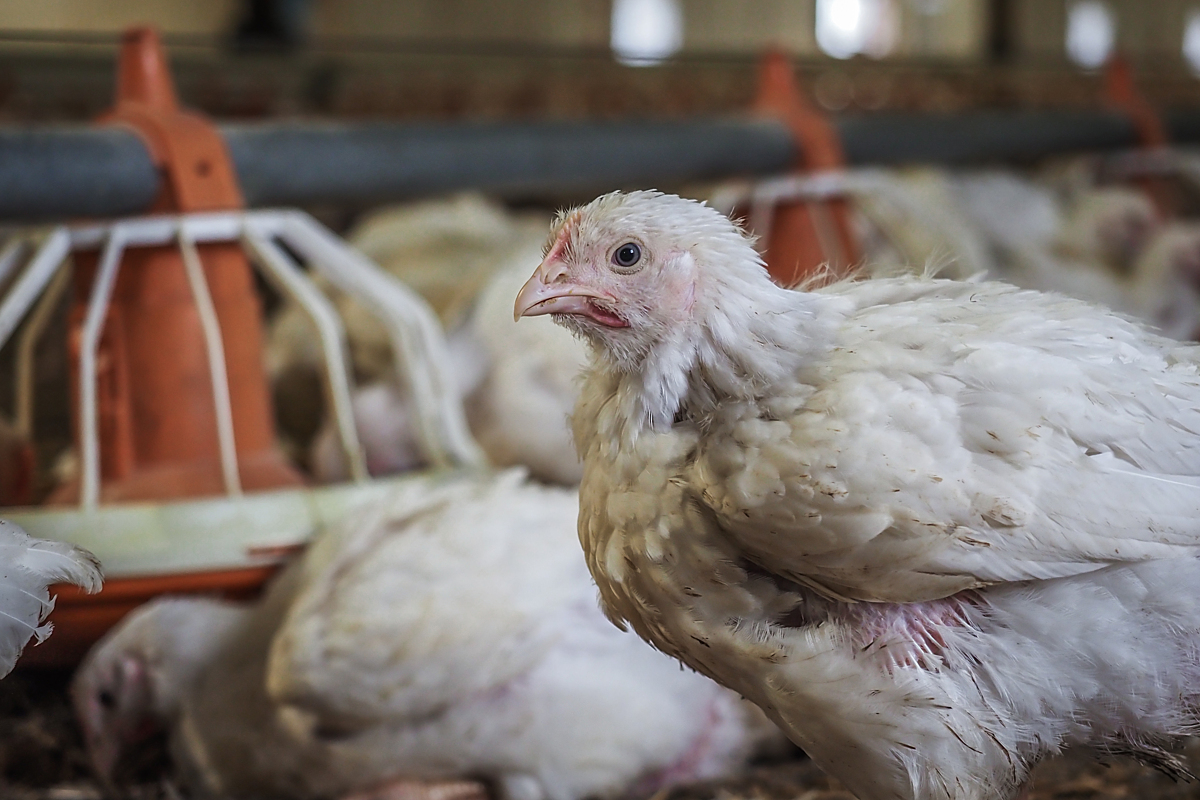
A young chicken living inside an industrial broiler chicken farm.

Lukas Vincour/Zvirata Nejime/We Animals

Sanctuary Questions: What About Meat Labeled 'Humane?'

Lukas Vincour/Zvirata Nejime/We Animals

This article is part of our Sanctuary Questions blog series. While touring our New York and California sanctuaries, visitors often express curiosity about the lives of our rescued farm animal residents. We’re sharing the most frequently asked questions and answering them here. Read on, and stay tuned for more.

Upon meeting our rescued animal residents and hearing their stories, many visitors to Farm Sanctuary feel inspired to adopt a more compassionate diet. They’re not alone—more consumers than ever are seeking out kinder alternatives to the cruelty and confinement of factory farming. 

It’s no surprise, then, that our tour guides frequently field questions about food products labeled “humane,” “organic,” and the like. Unfortunately, only a small number of these designations indicate slightly improved conditions for farm animals, and most are loosely regulated or deeply misleading.

The market for so-called “humane” products can be confusing to even the savviest consumers. This article offers an in-depth answer to the common question: “What about meat labeled ‘humane?’”
The Reality Behind the Marketing

When grocery shopping for themselves and their families, consumers should be able to trust that food labels are truthful, accurate, and well-regulated. But the images and descriptions on meat, dairy, and egg packaging often differ vastly from reality. Conscious consumers are appalled to learn that labels like “humanely raised” and “organic” mask production processes that are nearly indistinguishable from conventional factory farming. This deceptive marketing, known as “humanewashing,” is rampant across the animal products industry.

Beneath the facade, many animals raised on allegedly “humane” farms suffer from the same systematic cruelty as those on factory farms, including tail docking, debeaking, dehorning, castration without pain relief, forced impregnation, the separation of families, and an inevitable end at the same industrial slaughterhouses.

A Look at the Labels

With the wide array of certifications and labels on animal product packaging, shopping for more humane food can feel utterly perplexing. To ensure that food products align with customers’ values, it’s important to understand what the most common labels actually mean—and what they don’t.

American Humane Certified

American Humane Certified (AHC) standards vary widely by species and often fall short of guaranteeing true humane treatment. Further complicating matters, farms need only meet 85% of AHC’s criteria to be certified, leaving consumers in the dark about what level of welfare they’re paying a premium for.

Sadly, AHC allows for many practices commonly used in factory farming: Egg producers may keep egg-laying hens in group or “colony” cages, and pig producers may use gestation and farrowing crates to confine pregnant and nursing sows. For many animals—including broiler chickens, turkeys, and pigs—AHC allows for intensive indoor confinement without adequate outdoor access. While AHC producers must provide some animals with slightly more space than conventional farming, as well as certain basic enrichments like perches for chickens, the difference is still minimal. 

Producers like Butterball meet AHC criteria despite raising birds in large commercial barns, subjecting them to painful procedures like debeaking without anesthesia, and raising and killing turkeys in large enough numbers to supply 1 in 3 of those on Thanksgiving tables.

Certified Humane

Governed by the nonprofit Humane Farm Animal Care, Certified Humane is a much stricter label than AHC, but it still falls short of what most consumers expect.

Certified Humane does prohibit cages, crates, and tie stalls and requires that animals have space to move, stretch, and engage in natural behaviors. Chickens must be able to spread and flap their wings, and pigs must have space to root. Animals’ feed must not include animal byproducts, antibiotics, or growth hormones.

Despite these requirements, Certified Humane still doesn’t quite live up to its name. Producers are not required to offer access to pastures, and many animals never see the outdoors. Further, Certified Humane allows for slap marking, a form of tattooing in which a spiked metal plate with ink is pressed into a pig’s skin without anesthesia.

USDA Certified Organic

The USDA Certified Organic label is best known for prohibiting the use of synthetic hormones, toxic pesticides, GMOs, and antibiotics. Sadly, this doesn’t necessarily lead to improved animal welfare and, in fact, can have the opposite effect: Though producers are required to treat sick animals, some delay care to preserve their farm’s organic status for as long as they can.

Debeaking, dehorning, and tail docking are standard occurrences on organic farms, as is extreme confinement. Birds in organic facilities must have access to the outdoors, but this requirement is potentially meaningless. On many farms, tens of thousands of birds are packed into huge sheds, restricting their ability to move freely and reach the exits. Organic farms are also not required to provide enrichment materials that would allow animals to engage in their natural behaviors, such as rooting and foraging.

Certified Animal Welfare Approved

Certified Animal Welfare (AWA) is one of the highest welfare labels available in the United States. Products with the AWA label generally come from animals raised on pastures or with meaningful outdoor access. It requires that sick animals receive necessary medical treatment —including antibiotics—but forbids using these drugs to compensate for crowded, unhealthy conditions.

While AWA standards are higher, the average consumer is not likely to find products with this certification widely available in stores.

Generic terms: free-range, cage-free, pasture-raised, and grass-fed

  • “Free-range” and “free-roaming” labels are regulated by the USDA, but the bar is incredibly low. As little as five minutes of outdoor access per day can justify a “free-range” or “free-roaming” label.
  • For egg-laying hens, “cage-free” simply means they aren’t in battery cages. However, industry guidelines require only 1 to 1.5 square feet of space per hen, often leaving birds packed by the thousands into dark, crowded barns.
  • The terms “pasture-raised” and “pasture-grown” are vague and undefined by the USDA, allowing brands to use them purely as marketing fluff.
  • “Grass-fed” animals must have access to pastures, and their diets must include grass. Beyond what they eat, however, their treatment and living conditions remain largely unregulated.

Survivors of so-called "humane" farms

Many of the residents living safely at Farm Sanctuary today are survivors of so-called “humane” farming. Had they not found refuge with us, their bodies would have been processed and sold in grocery stores, wrapped in deceptive packaging. 

In stark contrast to their pasts in the food system, our residents now enjoy true humanity, safety, and care. At Farm Sanctuary, they eat nutritious diets, graze freely across open pastures, and enjoy daily enrichment activities to keep their minds sharp. Families and bonded friends stay together, and every animal receives compassionate, lifelong care.

Making truly humane food choices

When visitors discover that “humane” labels are often used to mask systemic cruelty, they are understandably upset. Even in the best cases, animals in the food system are still subjected to painful procedures, denied their natural lives, and sent to slaughter the moment their production declines.

To ensure your diet is genuinely kind to animals, we recommend choosing plant-based foods. By shifting your diet away from animal products, you can be certain that you are making a humane choice—while also benefiting your health and the planet. 

Making the switch doesn’t have to happen overnight. You can start gradually by swapping out meat in a few meals each week or replacing dairy milk with a plant-based alternative. Get started today with our Plant-Based Guide, complete with easy recipes and product suggestions.

Visit Us

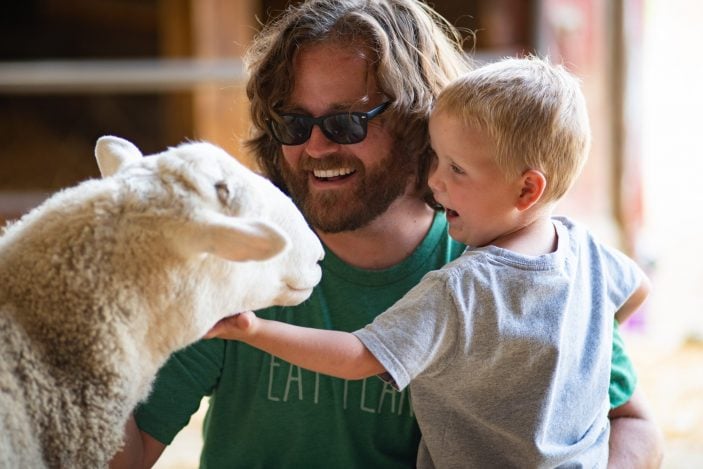
Farm Sanctuary visitors interact with rescued sheep

Farm Sanctuary was founded in 1986 to combat factory farming and transform our food system for animals, people, and the planet. At our sanctuaries in New York and California, we welcome visitors for public and private guided tours. You can even book a stay in one of our tiny houses or cabins in New York. We hope to see you soon!

Learn More